What Is the NCARB ARE 5.0? A Practical Overview of the Architect Registration Examination
For many aspiring architects, the Architect Registration Examination® is one of the final major steps on the path to licensure. Developed by NCARB, the National Council of Architectural Registration Boards, the ARE® 5.0 is designed to evaluate whether a licensure candidate can apply the knowledge and judgment needed in real architectural practice.
If you are preparing for the NCARB ARE 5.0, it helps to understand that this is not simply a memorization test. The current version of the exam focuses on decision-making, professional responsibility, and how architects think through real project situations. Understanding how the six divisions fit together can make studying far more effective.
Understanding the ARE 5.0 Exam Structure
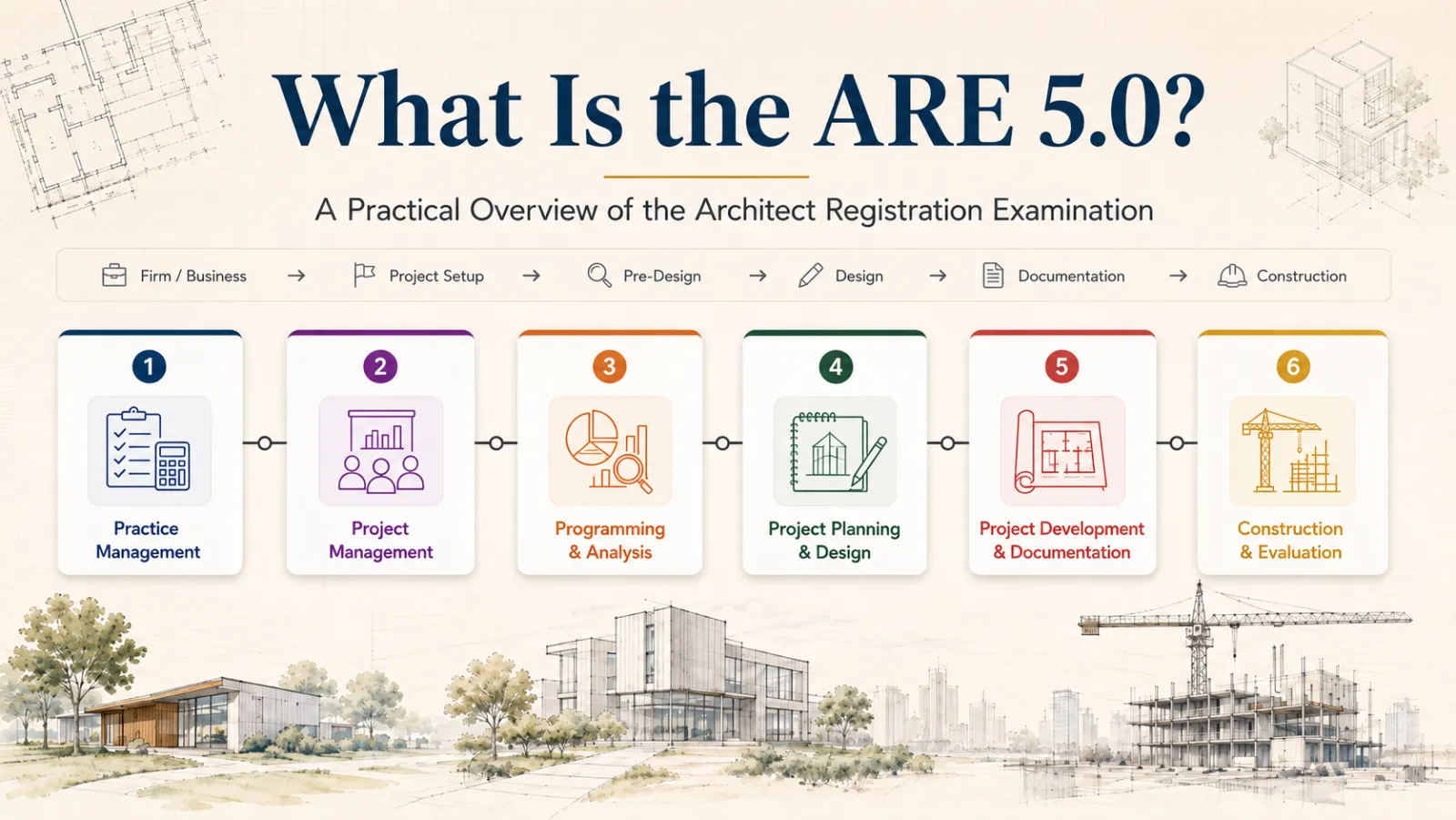
The ARE 5.0 exam consists of six divisions, each covering a different phase of professional practice and project delivery. Rather than viewing them as separate subjects, think of them as different points along the timeline of a typical architecture project.
The six ARE 5.0 divisions are:
- Practice Management
- Project Management
- Programming & Analysis
- Project Planning & Design
- Project Development & Documentation
- Construction & Evaluation
Together, these six divisions of ARE 5.0 evaluate the knowledge expected of future licensed architects. The division of ARE 5.0 reflects the broad responsibilities architects manage throughout a project, from firm operations to construction administration.
Practice Management and Project Management
The first two divisions focus heavily on business operations and project leadership.
Practice Management
This management division examines how architecture firms operate. Candidates are expected to understand ethics, risk management, financial performance, staffing, contracts, and professional responsibility. While many people associate architecture with design, this division focuses on the business realities that support successful practice.
Project Management
Project Management shifts attention from the firm to an individual project. Topics include owner-architect agreements, consultant coordination, project schedules, fees, communication, and project delivery methods.
Many questions in this exam division ask candidates to identify the architect’s responsibilities in a given situation. Success often comes from understanding how project decisions affect scope, risk, schedule, and client expectations.
Programming, Planning, and Design
The next two divisions move into project analysis and design development.
Programming & Analysis
This division focuses on gathering and evaluating information before design begins. Candidates may be asked to analyze site conditions, zoning requirements, climate data, code constraints, existing buildings, and owner goals.
The key concept is understanding how early project decisions influence everything that follows. A strong site analysis, for example, can shape building orientation, energy performance, accessibility, and overall project success.
Project Planning & Design
Project Planning & Design explores broader design strategies and system integration. Questions often involve building systems, structural concepts, accessibility, life safety requirements, site planning, and envelope design.
Rather than testing isolated facts, the exam objectives frequently require candidates to evaluate several competing factors and determine the most appropriate design solution. This reflects how architects make decisions in practice.
Project Development and Construction Evaluation
The final two divisions focus on technical documentation and construction administration.
Project Development & Documentation
This division becomes more technical and detail-oriented. Candidates should understand construction documents, specifications, material selection, building assemblies, and coordination between systems.
Many questions require evaluating how structural, mechanical, electrical, and architectural components interact. Understanding the relationship between drawings, details, and specifications is especially important.
Construction & Evaluation
Construction & Evaluation focuses on the architect’s role after the construction documents have been issued. Topics commonly include RFIs, submittals, change orders, pay applications, site observations, punch lists, substantial completion, and project closeout.
The emphasis is on understanding how architects evaluate construction progress and respond to issues while remaining within their professional responsibilities.
How NCARB ARE 5.0 Relates to Licensure
The ARE is only one component of licensure. Most jurisdictions also require completion of the AXP, or Architectural Experience Program, along with compliance with local licensing requirements.
As candidates gain architectural experience, many concepts encountered in practice directly reinforce material found on the exam. This connection between practice experience and testing is intentional. The exam is designed to reflect the knowledge needed for competent professional practice.
NCARB manages candidate records through the NCARB Record system. Maintaining an active NCARB Record helps candidates track progress toward eligibility to test and eventual architect registration. Because exam eligibilities vary by jurisdiction, candidates should always verify requirements with their licensing board and review current NCARB policies and procedures.
How This Topic Appears on the ARE Exam
Understanding the overall structure of the exam can help you prepare more effectively.
The actual exam includes multiple item types, including traditional questions and case studies. Case study items often require candidates to review project documents and apply information to realistic project scenarios. These questions test analysis and decision-making more than memorization.
NCARB also provides resources such as a demo exam, free practice materials, and a 5.0 practice exam environment. Taking the practice exams can help candidates become familiar with the exam format, the practice exam dashboard, and working through a practice exam in test mode or practice mode.
When preparing for exam day, focus on understanding project relationships rather than memorizing disconnected facts. Strong exam candidates can explain why a particular decision is appropriate, not simply identify the correct response.
You may also encounter references to the rolling clock, scheduling a division, an exam appointment, case study resources, and other testing procedures. While these administrative details matter, most of your study time should be devoted to understanding the practice of architecture and the reasoning behind professional decisions.
Study Takeaways for ARE Candidates
One of the most useful ways to approach the ARE is to view it as a multi-division exam that follows the progression of a real project. The six divisions are connected, and concepts often overlap from one section to another.
As you prepare for the exam, focus on understanding how projects move from initial analysis to design, documentation, and construction. Use study materials and practice questions that emphasize decision-making and application rather than simple recall. A practice test or test run can also help build confidence and familiarity with the testing interface.
There is no perfect order in which to take the exam. Because the divisions are taken in any order, some candidates start with the business-focused divisions, while others group technical divisions together. The best approach depends on your background, strengths, and overall test prep strategy.
Conclusion
The NCARB ARE 5.0 is designed to assess how well candidates can apply professional knowledge across the full lifecycle of an architecture project. From firm management to construction evaluation, each division reflects responsibilities encountered in real practice.
As you prepare for the architect registration examination, focus on understanding the logic behind decisions, the relationships between project phases, and the architect’s role throughout the process. The goal is not simply to memorize information, but to develop the professional judgment that supports effective architectural practice.
Ready to put this into practice? Try a free ARE 5.0 practice quiz and see how the six divisions show up in real exam-style questions.
ARE Academy helps aspiring architects pass the ARE 5.0 with practice questions, exam breakdowns, and study tools built around real architectural practice.